

Marketing
Why do some companies grow even in a crisis? The biggest differences between growth and stagnation

This is not an article about marketing. It is an article about business. Over years of working with clinics, online stores, real estate agencies and local businesses, we have seen the same patterns again and again. These are the principles that separate growing companies from stagnating ones.
Two companies. The same industry. Similar prices. The same region. And yet one grows and the other stagnates. Most business owners think the answer is more advertising. But advertising is only an amplifier. If you amplify something that doesn't work, the problem only gets bigger.

7 sec is how long a customer has to understand what a company does and what it means for them
95% of purchase decisions are made at an emotional, not a rational, level
10 principles separate companies that grow from those that stagnate
What companies that grow regardless of the market have in common
After years of working with clients of different sizes and industries (clinics, real estate agencies, online stores, construction companies, startups), we have noticed recurring patterns. The industry doesn't matter. The size doesn't matter. The principles are the same.
And interestingly, these principles have very little to do with advertising, followers or algorithms. They have everything to do with how a company understands its customers.
10 principles that set growing companies apart
1
They don't talk about themselves. They talk about the customer's problem.
Look at most websites. "We are a company with a long tradition." "We provide quality services." It sounds good. But the customer doesn't care. The customer is dealing with their own problem, pain or need.
Example: when someone's knee hurts, they don't look for "a clinic with a long tradition". They look for a way to get rid of the pain. When someone wants to sell a property, they don't look for "a professional real estate agency". They look for a buyer.
2
They simplify. People are overwhelmed, not stupid.
The winner is not the one who says the most but the one who explains things most simply. If customers don't understand what you do, who you help, why you're better and what to do next, they leave.
Simplicity is not a sign of weakness. It is a sign of expertise. The greatest experts can explain complex things simply.
3
They build trust before they sell.
The biggest mistake many companies make is trying to sell too early. Modern customers compare, read reviews, check references and visit a website several times. Successful companies build trust first. Only then do they sell.
Trust comes from quality content, case studies, real photos, videos, reviews, transparency and expertise. Not from advertising that says "We're the best".
4
They don't sell a service. They sell an outcome.
Nobody buys a drill. They want a hole in the wall. Nobody buys a website. They want customers. Nobody buys SEO. They want to be found. Nobody buys advertising. They want sales.
Many companies still sell their services. The most successful companies sell the outcome. That makes a huge difference in communication, price positioning and conversion.
5
They know where customers come from. They measure.
Many business owners invest in marketing blindly. They try ads. Social media. Flyers. SEO. And then they hope. Successful companies measure every channel.
Without data you have assumptions. With data you have decisions. Even a simple UTM parameter in a link tells you where a paying customer came from.
6
They don't look for miracle solutions. They have a system.
Every year a new trend. Facebook. Instagram. TikTok. AI. Automation. Many companies keep jumping from one to the next. The result is chaos. Successful companies do the opposite: they have a system and improve it step by step.
It's not as exciting. But it works. Consistent, measurable effort over 2 years beats any one-month campaign.
7
They understand value, not price. And they raise prices.
The cheapest offer rarely wins. If price alone decided, everyone would drive the cheapest cars. Customers don't buy a price. They buy value, certainty, trust, experience and an outcome.
That is why the most successful companies don't try to be the cheapest. They try to be the best choice. And customers are happy to pay more for the best choice.
8
They invest in their brand. Not just in advertising.
A brand is not a logo. A brand is the feeling people associate with your company. It is the answer to the question: "Why should I trust you in particular?" A strong brand works even when you are not advertising.
A strong brand lowers customer acquisition costs and increases referrals and loyalty. It is a long-term investment that pays back for years.
9
They adapt. Quickly and without panic.
The environment is changing faster than ever. AI, new customer behaviour, new platforms. What worked five years ago may not work at all today.
The biggest advantage is therefore not company size. It is the ability to learn and adapt faster than the competition.
10
They think long term. Not from campaign to campaign.
The biggest difference between successful and unsuccessful companies is not talent or budget. It is their time horizon. Many companies think in months. The most successful think in years.
They build a brand. They build trust. They build a system. They build relationships. And that is exactly why they grow even when the market stagnates.
11
AI won't save a bad business. It will only speed it up.
Companies today are looking for an AI tool that will solve marketing, sales or customer service. But AI only speeds up processes. If a company has no clear strategy, product or communication, AI just multiplies the problem. The most successful companies use AI to improve an existing system, not to replace one.
Example: ChatGPT can generate hundreds of posts. But if the company doesn't talk about the customer's problem, it will generate hundreds of posts that don't interest the customer. Faster. More. Without results. Read more in why most companies fail with AI.
Successful companies are not the ones with the most advertising. They are the ones that best understand their customers.
Why a customer leaves within 7 seconds: the empathy map of a modern buyer
Before a company starts any marketing, it must understand who its customer is at the moment they arrive on the website. Not who they should be. Who they really are.
What the customer feels
- Uncertainty: they don't know if this company is the right one
- Pressure: they are comparing several options at once
- Need: they are looking for a solution to a specific problem
- Scepticism: previous disappointment with other companies
What the customer is looking for
- Proof that the company understands their problem
- A concrete outcome, not a list of features
- A reason why this company and not another
- A clear next step without unnecessary effort
What the customer does
- Scans the page for 3 seconds before reading
- Reads reviews before making any contact
- Visits the website 2 to 4 times before deciding
- Compares with competitors in the same browser
What the customer fears
- Paying and not getting a result
- Wasting time with an unreliable company
- Making the wrong decision and regretting it
- Being misled by unrealistic promises
When a company understands these 4 quadrants, every section of the website, every CTA and every piece of copy takes on a different meaning. Not "show what you can do" but "reassure the customer, answer their fear, give them proof, show them the way".
An example from practice: a dental clinic
We changed one sentence on the homepage. Enquiries rose by 83%.
The client had a functional website, a good team and satisfied patients. The problem: the homepage opened with "We are a modern dental clinic with a 15-year tradition and state-of-the-art equipment." Analytics showed that 78% of visitors left the page within 8 seconds.
What we found: patients don't come looking for tradition or equipment. They come with a specific fear: pain, neglected dental hygiene, an aesthetic problem. The website didn't answer that fear.
What we changed: the first sentence became: "Toothache, or afraid of the dentist? We also help patients who haven't been to a dentist in a long time." Below it: specific solutions by problem. A contact form asking "What's troubling you?" instead of "Contact us".
+83% increase in enquiries through the website within 8 weeks
-71% drop in bounce rate: visitors stay and read
1 sentence changed on the homepage caused the whole turnaround

An example from practice: an accounting firm, central Slovakia
The client came for a new website. They left with a solution that increased enquiries by 91%.
The client ran an accounting firm with 6 employees. They came with a clear request: "We want a new, more modern website." The website really did look dated. But that wasn't the problem.
What we found: the website talked about the company, certificates, the team and years of experience. But a customer looking for an accountant couldn't find out one key thing: "Will you help me, with my type of business?"
What we did: instead of a new design, we first rewrote the communication. Every section began with the customer's problem, not the company's service. We added specific client examples by type of business: sole trader, limited company, online store, freelance profession.
Only then did we create the new design. Based on the new communication, not the other way round.
+91% increase in enquiries through the website within 10 weeks of changing the communication
Communication was the real problem, not design, as the analytics confirmed
Principle 1: talk about the customer's problem, not about yourself, in practice
Do you sell a service or an outcome? The difference that changes everything
This is one of the most powerful shifts any company can make, without a new website, a bigger budget or new channels. Just communicate what you do differently.
The company sells
The customer wants
The right message
A website with modern design
More customers and enquiries
"A website that works for you"
SEO
To be found by customers
"Customers looking for you will find you"
An apartment renovation
A finished apartment without stress or waiting
"Delivered on time and without surprises"
Legal advice
Certainty that everything is in order
"No surprises. Clear answers."
Financial planning
Peace of mind and control over finances
"You know exactly where you stand and where you're going"
Does your website sell an outcome or just a service? A free analysis of your communication and UX. Specific recommendations within 24 hours.


Why price is not your problem: on value and positioning
One of business owners' most common worries: "Customers only compare prices." Our experience says otherwise.
Customers compare prices when they don't understand the differences in value. If your website can't explain why you are different and better, the customer has no choice but to compare numbers. That is not the customer's problem. It is a communication problem.
An example from practice: a real estate agency
We raised prices by 30%. The number of clients grew.
The client had a real estate agency with 8 agents. They kept hearing the same question from customers: "Why are you more expensive than XY?" Their commissions were below average, but customers still looked for a discount.
The problem: the website presented the same things as everyone else. A professional team. Ten years of practice. Satisfied clients. No real reason to pay more.
What we changed: the website started communicating concrete results: average time to sell, the percentage of clients who got more than the original asking price, real sales stories with numbers. We raised commissions by 30%. Customers started coming with the question "Can you help me sell?" instead of "How much do you charge?"
+30% increase in commissions without losing clients
+44% increase in enquiries through the website within 4 months
0 "why are you more expensive" questions after the new value communication
Why AI won't help a company that hasn't sorted out the basics
This is probably the most important addition to the 10 principles we have described. Many companies today reach for artificial intelligence as a cure for stagnation. But AI is an amplifier, not a rescuer.
If a company doesn't talk about the customer's problem, AI will generate more copy that talks about the company. If a company has no system, AI will speed up the chaos. If a company sells a service instead of an outcome, AI will sell it the same way.
That is why 4 basic conditions must be met before introducing AI:
Condition
Without it, AI produces
With it, AI brings
Clear value communication
More generic content
Scalable content that converts
A working sales process
A faster chaotic process
An automated, efficient funnel
Measurement and analytics
More data without context
Decisions backed by real numbers
Understanding the customer
Personalisation for the wrong personas
AI that speaks the customer's language
AI is available to every company today. The advantage therefore won't come from who has AI. It will come from who has the right foundations for AI to build on. Read more about why most companies fail with AI and what the companies it works for do differently.
Conclusion: what separates growing companies from stagnating ones
Technologies will change. Marketing channels will change. Algorithms will change. But companies that understand people's needs and create real value for them will still be successful in ten years.
The 10 principles in brief
What growing companies do
- Talk about the customer's problem, not about themselves
- Simplify instead of complicating
- Build trust before selling
- Sell an outcome, not a service
- Measure where customers come from
- Have a system instead of chasing trends
- Understand value, not price
- Invest in their brand for the long term
- Adapt quickly
- Think in years, not months
Every successful digital project stands on these principles. Not on follower counts. Not on the size of the ad budget. On a deep understanding of the customer.
Read on
Why a beautiful website is not enough: a website that sells SEO vs AIO: the future of search in 2026 Branding, brand trust and websites Why companies fail with AI AI is changing marketing: what it means for you Pricing: web, branding, marketing
Is your company growing the way it should?
We will look at your website, communication and digital presence and find out where customers are getting lost and why. Specific recommendations, not general advice. Free, within 24 hours.
Article by Rebeka Ďurišová, ReVisual Studio. Share it with a business owner who thinks their problem is a lack of advertising.
More insights
 1 June 2026Pricing psychology and customer decisions: why a low price often reduces salesFind out why a low price often reduces customer trust. A practical guide to pricing psychology, perceived value and strategies that help companies sell at the right price.
 29 May 2026SEO is not dead. But it is changing more than in the last 15 years.SEO is changing. Semantic SEO, AI search, GEO and AIO shape the results on Google and ChatGPT. Find out how to prepare your website for 2026.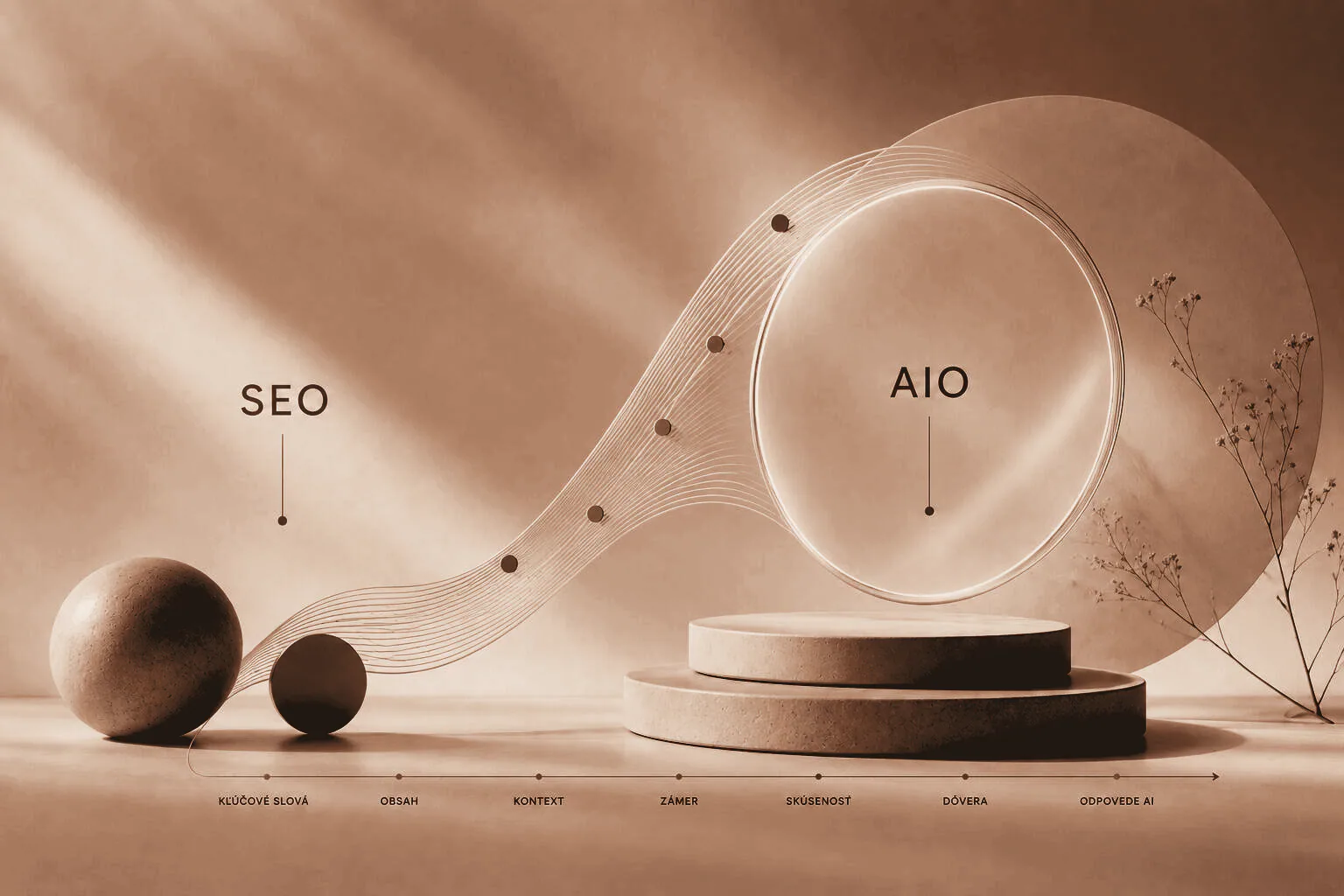
Next step
Tell us where you want to go. We will plan the route together.
The first consultation is free and without obligation. We go through your goals, and afterwards you receive a proposed solution with an indicative price.
Start my project