

Marketing · Web · SEO and AI
SEO is not dead. But it is changing more than in the last 15 years.
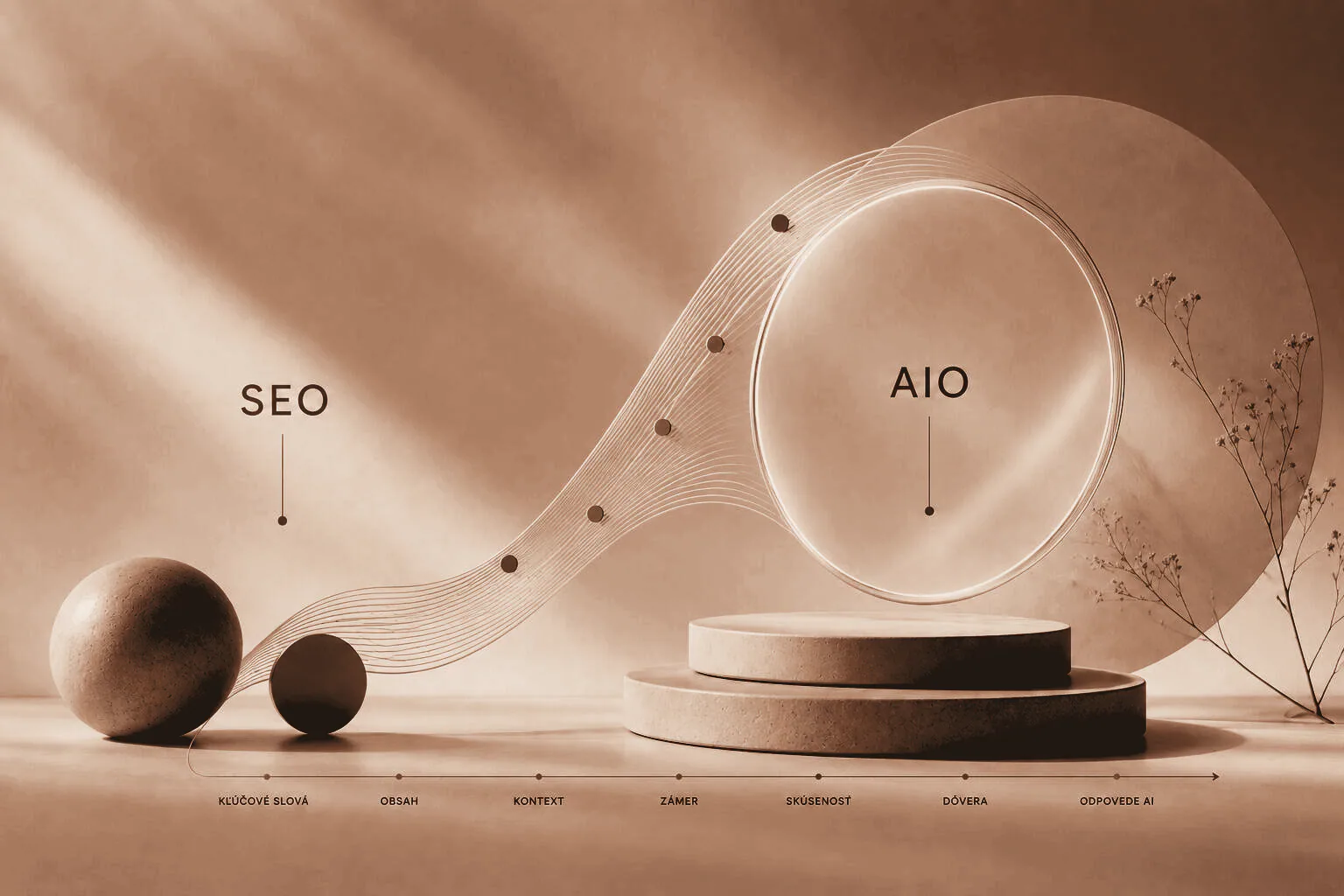
This is not another SEO article full of theory. These are insights from talks and conferences by leading experts in search, AI and digital behaviour. And from real projects where we have seen these changes with our own eyes.
Why is your organic traffic falling even though you add content regularly? Why have competitors overtaken you even though you have more articles? Why doesn't your website bring enquiries even though you have invested in SEO? The answer is not in the number of articles. It is in how search works in 2026.

60% of Google searches end without a click to a website
AI answers appear in Google for 65% of queries in 2026
3x faster growth of AI searches than classic Google
What is really happening with search in 2026
For many years the internet worked simply. A user typed a question. Google showed a list of websites. The user clicked. The company got traffic.
Today this model is breaking down. More than 60% of Google searches end without a click to any website. The user gets the answer directly in the results, without needing to visit a page. And that number grows every month.
On top of that, there are new places where people look for information. ChatGPT. Gemini. Perplexity. Claude. People don't just ask a search engine. They ask AI. And AI answers them directly, without a link to your website.
1
Until 2020
Keywords and backlinks
You chose a keyword, optimised your page and got links. Google showed results as a list of links. A click was almost certain.
2
2020 to 2024
E-E-A-T and topical relevance
Google started evaluating experience, expertise, authoritativeness and trustworthiness. A keyword was no longer enough. Context, depth of content and the credibility of the source mattered.
3
2025 to 2026
AI Overviews and zero-click search
Google generates answers directly in the results. More than 60% of searches end without a click. At the same time, the share of searches through ChatGPT, Gemini and Perplexity is growing.
4
2027 and beyond
Topical authority and AI citability
The goal won't just be the first page of Google. The goal will be to be cited in AI answers. Brands with deep, authoritative content will dominate. The rest will disappear.
Why old SEO doesn't work: what has changed in Google's algorithms
Many companies still invest in SEO the way it worked in 2020. They choose keywords. Write a few articles. Optimise titles. Get a few backlinks.
And the results come more and more slowly. Or not at all.
The problem is not SEO as such. The problem is an approach that ignores how search engines really work today.
SEO in 2020
What worked then
- Optimising one keyword per page
- As many backlinks as possible, even low-quality ones
- Long content just for the word count
- Technical optimisation as the main factor
- Duplicate content across different pages
- Fast results within 3 to 6 months
SEO in 2026
What works today
- Topical authority through a content ecosystem
- Quality backlinks from relevant sources
- Content that genuinely answers the user's intent
- UX, speed and user experience as SEO factors
- Unique perspectives, experience and data
- A long-term strategy for building authority

What semantic SEO is and why it is the most important shift of recent years
A tale of two companies: why 50 articles weren't enough and 8 won
Company A invested a year and a half in SEO. It wrote 50 articles. Each was optimised for a different keyword. Each was technically fine. And organic traffic stagnated.
Company B wasn't first. It didn't have a bigger budget. It didn't have a better product. But it had a different strategy. Instead of 50 isolated articles, it created 8 deep pillar pages linked into content clusters. Each cluster built topical authority in a specific area. Each topic was covered from several angles. Every piece of content linked to the others.
A year later, company B had 3 times more organic enquiries than company A. Not because it had more content. Because Google saw it as an authority on the topic.
This is semantic SEO in practice.
Imagine two specific companies in healthcare.
The first writes one article: "Treating knee pain." It optimises it for the keyword, adds a few links and waits for results.
The second builds an entire content ecosystem: knee pain, osteoarthritis, cartilage damage, rehabilitation, sports injuries, recovery, prevention, case studies, expert explanations, frequently asked questions. Every piece of content links to the others. Each builds on the same topics from different angles.
Neither Google nor AI systems think in keywords. They understand context, the relationships between topics and the depth of knowledge. And that is exactly what semantic SEO is: the foundation of every modern web strategy.
Old SEO logic
Semantic SEO logic
Result
1 page = 1 keyword
A content cluster around a topic
Authority across the whole subject
As many links as possible
Relevant, authoritative sources
Credibility in Google's eyes
Content for the algorithm
Content for a real person
Long-term organic traffic
Fast results within months
Systematic authority building
Sustainable growth over years
Generic content for everyone
Deep content with a unique perspective
Citability in AI answers
An example from practice: e-commerce on the Slovak market
Rebuilding an SEO strategy from keywords to topical authority.
The client sold sports nutrition supplements. They had 47 product pages optimised for keywords. Organic traffic had stagnated for two years despite regular article publishing.
The problem: every article was optimised in isolation. No topical connections. Google didn't know whether the company was an authority on nutrition, fitness or sport in general.
What we changed: we built 6 topic clusters around the main pillars: protein, recovery, performance, weight loss, vegan nutrition and women's sport. Each cluster had a pillar page and 8 to 12 supporting articles linked together. All content was written with E-E-A-T signals, including real experts.
+340% growth in organic traffic within 9 months
61 new keywords in Google's top 3
+89% growth in conversions from organic traffic
AIO and GEO: how to be cited in AI answers
In professional circles there is more and more talk of concepts that most marketers in Slovakia are only beginning to grasp. Google AI Overviews, ChatGPT search, Perplexity AI and Gemini are fundamentally changing where and how people look for answers.
AIO (AI optimisation): optimising content so that AI systems consider it a trustworthy source and cite it in their answers. People also talk about entity SEO: building the identity of a brand and its entities so that AI recognises them and associates them with specific topics.
GEO (generative engine optimisation): a strategy for building a presence in generative search engines such as ChatGPT, Gemini, Perplexity or Claude. Some experts also call it search experience optimisation: optimising the whole search experience across all platforms.
When someone asks ChatGPT: "What is the best web agency for e-commerce in Slovakia?", the AI doesn't run a real-time search in the classic sense. It draws on content that was included in its training or is available through web search. Companies with authoritative content will be cited. The rest will be ignored.
How to get into AI answers: 5 key factors
- Topical depth: cover the topic more thoroughly than anyone else in your segment
- Citable facts: use specific numbers, data and unique insights worth quoting
- E-E-A-T signals: experience, expertise, authority and trustworthiness in every piece of content
- Structured content: FAQ schema, a heading hierarchy and clear answers to specific questions
- Media mentions: external sources that talk about you build authority in AI systems too
Want to know where your company stands in semantic SEO? A free audit of your content and topical authority. Results within 48 hours.

The biggest misconception about AI content: why quantity isn't enough
One of the most striking ideas shared by AI and UX experts: AI can create very convincing content that may be completely wrong.
It can create personas that never existed. It can describe user scenarios nobody uses. It can write marketing copy that sounds professional but doesn't work. And Google is getting better and better at recognising it.
What AI content can do
- Cover broad topics quickly
- Structure information
- Variations and A/B copy
- First drafts and outlines
Where AI fails
- Unique perspectives and experience
- Real case studies
- Professional nuance and context
- Understanding the local market
What Google rewards
- E-E-A-T: experience and authority
- Content Google can't find elsewhere
- Real data and examples
- Deep topical coverage
The risk for companies
- Penalties for generic AI content
- Loss of user trust
- Invisibility in AI answers
- Dependence on paid advertising
The paradox: AI will become an ever more important helper in content creation. But human judgement, experience and a unique perspective will become even more valuable, not less. Exactly what AI can't provide will decide success in SEO.
An example from practice: a local firm vs. AI content
Why a company with less content beat a competitor with a blog 10x bigger.
The client provided legal services in commercial law. A competitor had 200+ AI-generated articles. Our client had 18 detailed articles written by real lawyers, with specific cases and case law.
The result after 6 months: the client with 18 articles outranked the competitor with 200 on 34 of 40 tracked keywords. Google rewarded depth, authority and real experience. The generic AI content was gradually devalued.
34/40 keywords won against a competitor with 10x more content
18 in-depth articles beat 200 generic AI texts
+156% growth in enquiries from organic traffic within 6 months
UX as an SEO factor: why user experience decides rankings
One of the strongest ideas in modern UX research: "People don't buy features. They buy a feeling." You can read more about how this works in practice in our article why a beautiful website is not enough.
The same applies to SEO. Google tracks user behaviour. If people come to your website and leave immediately, the algorithm interprets it as a signal of low quality. If they stay, read and act, Google rewards it with higher rankings.
Core Web Vitals
LCP, FID, CLS. Loading speed, interactivity and visual stability have been direct ranking signals since 2021. In 2026 they matter even more.
Bounce rate and time on page
If a user leaves after 5 seconds, Google sees it. Long time on page and a low bounce rate signal quality content.
Click-through rate
If nobody clicks your search results, Google lowers your position. The title tag and meta description must sell the click.
Mobile UX
More than 60% of searches happen on mobile. Google primarily indexes the mobile version of a website. If mobile UX doesn't work, the page loses rankings.
Structure and navigation
A clear URL structure, breadcrumbs, internal linking and a logical hierarchy help Google understand the content and help users find what they are looking for.
PageSpeed as a brand signal
A slow website seems less trustworthy. Loading speed affects not only SEO but also the conversion rate and brand perception.
The smarter search engines and AI systems become, the more they will reward real quality. And the less any shortcuts will work.
A framework for SEO in 2026: what every website must have
Good SEO in 2026 combines four interconnected layers. A missing layer weakens the whole strategy.
Layer
What it includes
Why it is critical
1. Technical SEO
Speed, Core Web Vitals, indexing, structure
The foundation without which the other layers don't work
2. Content authority
Topic clusters, E-E-A-T, depth and uniqueness
Decides long-term visibility and AI citability
3. UX and conversion
User behaviour, CTAs, readability, navigation
Turns traffic into enquiries, and Google rewards it
4. Authority and trust
Backlinks, PR, mentions, brand signals
Credibility in the eyes of Google and AI systems
An example from practice: a fintech startup
From zero to the first page of Google in 8 months without paid advertising.
A new client with no domain history, no backlinks and no content. The competition: an established financial institution with a 15-year history. The goal: organic traffic and enquiries without depending on paid campaigns.
The strategy: instead of fighting for the main keywords, we built authority in the long tail. Detailed answers to specific questions the competition ignored. Every piece of content with real authors, sources and examples. A technically flawless website with a PageSpeed score of 97.
8 months from zero to the first page of Google for 23 keywords
€0 invested in paid advertising throughout
97 PageSpeed score as the technical foundation of the strategy
The future of SEO belongs to brands, not tricks: what the data shows
For many years companies tried to outsmart the algorithm. They looked for SEO tricks. Marketing hacks. Quick fixes. They bought backlinks. They generated content by the kilo.
The AI era is heading in exactly the opposite direction. The smarter the algorithm, the harder it is to fool. And the easier it is to win with quality.
Summary of key conclusions
What AI and Google will reward in the coming years
- Topical authority, not the number of articles
- Real experience and unique perspectives
- Content that genuinely helps a specific person
- Technical excellence and speed as a brand signal
- Credibility built over years, not with tricks
- UX that leads to a decision naturally
This is the shift confirmed by both data and practice. SEO is not dead. But SEO without a strategy, without authority and without understanding customer behaviour is quickly becoming a wasted expense.
What every company should do for SEO in 2026: 6 concrete steps
This section is for you if you don't just want to read about the changes but want to know what to do about them. Concrete steps, in the right order.
Step
What to do
Why it works
1. Stop creating content just around keywords
Define 3 to 5 main topics you want to be an authority on
You build topical authority, not random articles
2. Build content clusters
For each topic, create a pillar page and 5 to 10 supporting articles
Google starts to see you as an expert on the subject
3. Improve UX and website speed
PageSpeed above 90, clean navigation, clear CTAs. Read more about why website speed decides both SEO and sales.
A lower bounce rate = better SEO signals and a higher conversion rate
4. Work with E-E-A-T signals
Real authors, concrete experience, verifiable sources and data
Your credibility with Google and AI systems grows
5. Optimise for AI search
FAQ schema, structured answers, entity SEO, citable facts
Your brand appears in answers from ChatGPT, Gemini and Perplexity
6. Measure business results, not just rankings
Track enquiries, conversions and revenue from organic search, not just rankings
You see what really brings business value
What this means for a business owner in 2026
No team of SEO specialists? Here is what you need to know.
If you have a website from 2020 and still publish articles based only on keywords, it is highly likely that competitors with better UX and topical authority will gradually overtake you. Even if they have less content.
Having more articles is not enough. Having a cheaper product is not enough. In 2026, Google and AI systems reward companies that understand their customers, create content with depth and have a website that really works.
The good news: in Slovakia, the vast majority of companies aren't doing this yet. Whoever starts building topical authority today will have an advantage in 12 months that will be hard to catch up with.
12 months is enough to build topical authority in a smaller segment
3x higher organic growth with a topic-based vs. a keyword-based SEO strategy
Today is still the ideal time to start, while most competitors are asleep
What you can do for your SEO today: a practical checklist
Theory without action changes nothing. Here is a concrete approach you can start implementing this week, without an agency, a big budget or technical knowledge.
A 5-point SEO audit you can do yourself in an hour
- Check your Core Web Vitals: enter your URL in Google PageSpeed Insights. If the score is below 70, you have a technical problem that holds back every other SEO effort.
- Map your main topics: write down 3 to 5 topics you want to be an authority on. Do you have at least 5 interlinked articles for each? If not, you have a content gap.
- Check the FAQ on your website: do you answer the questions your customers actually ask? You can find these questions in Google Search Console under "Queries" or simply in Google autocomplete.
- Test your internal linking: click on any article and count how many links lead to other pages on your website. Fewer than 3 internal links is a problem.
- Try asking ChatGPT or Gemini: ask a question from your field. Did your company or website appear in the answer? If not, you are invisible to AI.
A company without a strategy
What they do today
- Write articles without topical connections
- Optimise every page in isolation
- Measure rankings, not enquiries
- Ignore UX and website speed
- Don't know whether they are visible in AI
A company with a strategy
What they do differently
- Build topic clusters of content
- Connect content into an ecosystem
- Measure enquiries and conversions from organic search
- PageSpeed above 90 is standard, not a bonus
- Actively build AI citability
No time for an audit yourself? We'll do it for you. Technical SEO, topical authority, UX and AI visibility. Concrete findings within 48 hours.
What this means for your website and business
The Slovak market is in an interesting position. Companies that invest today in website design and development with SEO and UX in mind will have a huge advantage in 2027. Semantic SEO, AIO and GEO are concepts most local agencies don't even know. That is a huge opportunity for companies that start building topical authority now.
Your competitors are probably still doing SEO the old way: keywords, a few articles, basic optimisation. If you want to know what a specific SEO and content strategy costs, see our pricing for digital services. If you start building real topical authority today, in 12 months you will hold positions they won't reach even in 3 years.
Related topics
Why a beautiful website is not enough: customer psychology Custom website design Website speed: the silent killer of sales and SEO ReVisual SEO and web pricing Blog on UX, SEO and conversions
Where does your SEO stand in 2026?
A free audit of your website's topical authority, technical SEO and UX. Concrete findings, not general recommendations. Results within 48 hours, with no obligation.
Article by ReVisual Studio, based on current insights from digital marketing and our work with clients. Share it with someone who is still doing SEO by the rules of 2020. You can find more on digital strategy on our blog about UX, SEO and conversions.
Frequently asked questions
What is semantic SEO?
Semantic SEO is an approach that builds topical authority instead of optimising individual keywords. Google understands context and the relationships between topics. Companies with a deep content ecosystem on a topic win over those that optimise individual articles.
More insights
 1 June 2026Why do some companies grow even in a crisis? The biggest differences between growth and stagnationWhy do some companies grow during crises while others stagnate? Discover the strategies, marketing principles and decisions that separate growing companies from the rest.
 1 June 2026Pricing psychology and customer decisions: why a low price often reduces salesFind out why a low price often reduces customer trust. A practical guide to pricing psychology, perceived value and strategies that help companies sell at the right price.
Next step
Tell us where you want to go. We will plan the route together.
The first consultation is free and without obligation. We go through your goals, and afterwards you receive a proposed solution with an indicative price.
Start my project